

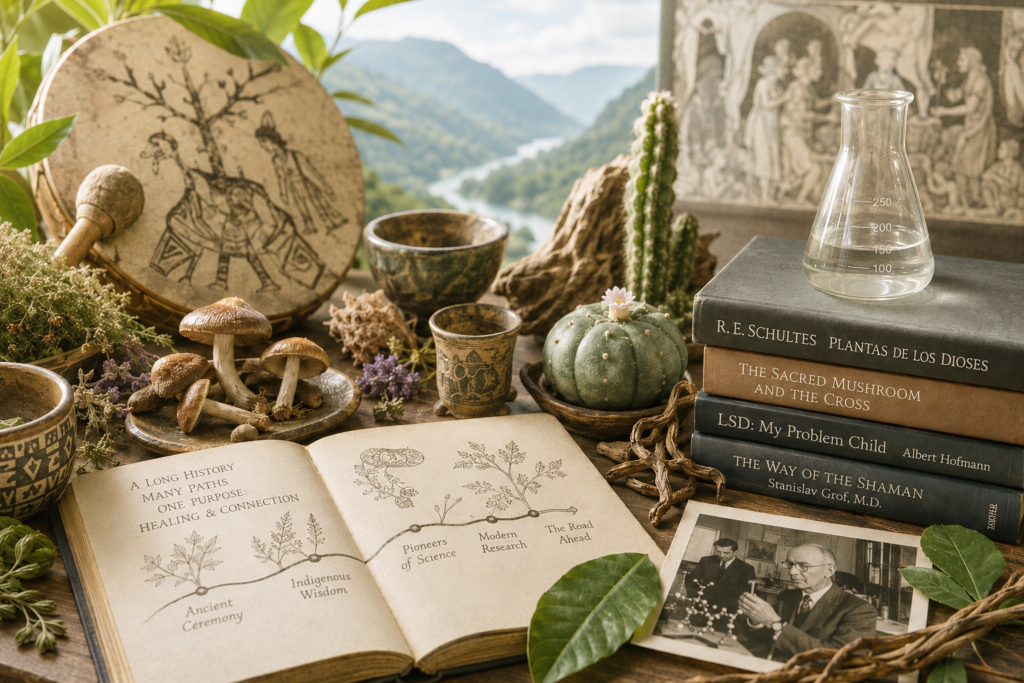
In Post 1 of this series, I made the case that the relationship with a plant matters as much as the compound it contains. That before we can talk intelligently about psilocybin therapy or ayahuasca-assisted healing, we have to understand what these medicines are in their full context, i.e. not just what they do to the brain, but what they have meant to human beings across thousands of years of intentional, ceremonial use.
This post is an attempt to elucidate that history.
It is also a cautionary tale about what happens when ancient knowledge meets modern systems: what gets preserved, what gets lost, and what questions that raises for those of us working at this intersection today.

The word psychedelic was coined in 1957 by British psychiatrist Humphry Osmond, from the Greek words for mind (psyche) and manifest (deloun). It was intended to describe substances that made the contents of the mind visible, i.e. for the expansion of consciousness.
The word entheogen came later, in 1979, coined by a group of scholars including ethnobotanist Richard Evans Schultes, philosopher Carl Ruck, and mythologist Robert Gordon Wasson. It derives from the Greek entheos (the divine within) and genesthai (to come into being). The intent was to distinguish ceremonial and spiritual use from the recreational framing that “psychedelic” had accumulated through the 1960s counterculture.1
The distinction reflects a fundamentally different understanding of what these substances are and what they are for. In entheogenic traditions, the plant is not a drug that produces an effect. It is a teacher, a guide, a living intelligence that you enter into relationship with. The ceremony surrounding its use is not decoration. It is an integral part of the medicine.
“Psychedelics, used responsibly and with proper caution, would be for psychiatry what the microscope is for biology or the telescope is for astronomy.” — Stanislav Grof
The use of psychoactive plants in ritual and spiritual practice predates written history. Archaeological evidence suggests shamanic practices involving altered states are among the oldest cultural traditions of our species — appearing across geographically and culturally unconnected civilizations on nearly every inhabited continent.
In the Americas, peyote use among indigenous peoples of Mexico and the American Southwest has been documented archaeologically to at least 5,700 years ago.2 Psilocybin mushrooms appear in rock art and ritual objects throughout Mesoamerica. Ayahuasca, the Amazonian brew combining DMT-containing plants with a vine that prevents their breakdown in the digestive tract (MAOI). This practice has been central to healing and spiritual practice across dozens of Amazonian traditions for an estimated over one thousand years, though oral traditions place it far older.
In the ancient world, the Eleusinian Mysteries have been the most celebrated religious rites of ancient Greece, attended for nearly two thousand years by figures including Plato, Sophocles, and Marcus Aurelius. They’re centered on the ingestion of a grain-based drink called kykeon. Classics scholar Carl Ruck and others have argued compellingly that kykeon contained ergot-derived psychoactive compounds, making it a likely precursor to what Albert Hofmann would later synthesize as LSD.3
The point is not that psychedelics are ancient and therefore safe or automatically beneficial. The point is that these are not new, experimental, or fringe. They are part of the oldest documented spiritual and healing traditions in human history. That context belongs in any honest conversation about what they are.
Schultes is often called the father of modern ethnobotany, and the title is well deserved. He spent over a decade living among indigenous peoples of the Amazon, documenting their relationships with psychoactive plants such as ayahuasca, peyote, psilocybin mushrooms — with a rigor and a depth of cultural respect that was unusual for his era.4 He understood that the knowledge he was documenting lived in relationship, not in compounds, and he said so repeatedly. His work gave Western science its first serious scientific vocabulary for understanding plant-based psychedelics.
Swiss chemist Albert Hofmann synthesized LSD from ergot fungus in 1938, and accidentally discovered its psychoactive properties in 1943 during what has become the most famous bicycle ride in the history of pharmacology.5 He also isolated psilocybin and psilocin from Psilocybe mushrooms in 1958, working alongside mycologist R. Gordon Wasson. Hofmann spent the rest of his long life insisting that these substances had profound therapeutic and spiritual potential, when used responsibly, and in appropriate contexts. His book LSD: My Problem Child remains essential reading.
German anthropologist and ethnopharmacologist Christian Rätsch authored the Encyclopedia of Psychoactive Plants. This is one of the most comprehensive catalogs of psychoactive species ever assembled, detailing the botany, chemistry, history, and cultural uses of hundreds of plants.6 Rätsch was also a passionate advocate for indigenous cultures and the ritualistic and medicinal roles of entheogens, and a persistent voice against the reduction of plant medicine to pharmaceutical commodity.
Czech psychiatrist Stanislav Grof conducted extensive research with LSD and psilocybin in therapeutic settings in the 1950s and 1960s, developing the theoretical framework of holotropic states of consciousness to describe the non-ordinary states these substances produce.7 His work helped establish that the therapeutic potential of psychedelics lies not in the drug itself but in the quality of the experience it facilitated. This insight has shaped every serious clinical research program since.
The modern Western story of psychedelics begins in the 1950s, when LSD and psilocybin were actively studied by the psychiatric mainstream as promising treatments for depression, anxiety, trauma, and addiction. As author Michael Pollan documents in How to Change Your Mind, many in the psychiatric establishment regarded these substances in that era as genuine wonder drugs, as tools that could do in one or two sessions what years of talk therapy could not.
Then came the 1960s. Psychedelics became entangled with political counterculture, antiwar movements, and a broader cultural upheaval that the American political establishment found threatening. Timothy Leary’s famous injunction to “turn on, tune in, drop out” gave policymakers exactly the cover they needed. By 1970, LSD and psilocybin were placed on Schedule I, as substay with no accepted medical use, and high abuse potential.
The scheduling decision was not made on scientific grounds. It was a political decision, made in a climate of moral panic, that reversed decades of promising research and cut off a generation of psychiatrists from tools they had found genuinely useful. And it effectively ended all clinical research for two decades.
“For most of the 1950s and early 1960s, many in the psychiatric establishment regarded LSD and psilocybin as ‘wonder drugs’ for treating depression, anxiety, trauma, and addiction. As these drugs came to be associated with the 1960s counterculture… the exuberance surrounding these new drugs gave way to moral panic.” — Michael Pollan, How to Change Your Mind
Nevertheless, indigenous ceremonial use continued uninterrupted. Mazatec healers in Oaxaca kept working with psilocybin mushrooms. Amazonian curanderos kept preparing and administering ayahuasca. The Native American Church kept serving peyote in ceremony. While the medicine did not disappear, the mainstream conversation about it did, along with scientific inquiry.
No discussion of the history of entheogens is complete without addressing Terence McKenna’s Stoned Ape Theory, proposed in his 1992 book Food of the Gods. McKenna argued that the ingestion of psilocybin-containing mushrooms by early hominids (possibly Homo erectus) played a pivotal role in the rapid cognitive expansion that distinguishes Homo sapiens, contributing to the emergence of language, symbolic thinking, art, and self-awareness.8
It is a compelling idea, and McKenna was a brilliant and provocative thinker. But to date, it is not accepted science. It is a speculative hypothesis with no direct empirical support. McKenna himself, and later his brother Dennis McKenna, acknowledged it was unprovable with current tools.
The core scientific objections are significant. Psychedelic-induced changes in an individual’s cognition do not appear to be inherited genetically. There is no known mechanism by which a psilocybin experience could alter the germline and pass to offspring.9 Additionally, the timeline McKenna proposed does not align cleanly with the fossil and archaeological record of cognitive development in hominins.
Competing theories for human cognitive evolution are better supported by evidence and deserve equal consideration here:
The Social Brain Hypothesis, developed by anthropologist Robin Dunbar, proposes that increasing social complexity, such as managing larger group sizes, tracking alliances, navigating reputation — drove the expansion of primate and human brain size.10 Language, by this account, evolved primarily as a tool for social bonding and information sharing.
The Cooking Hypothesis, associated with primatologist Richard Wrangham, argues that the control of fire and the cooking of food unlocked dramatically more caloric energy from the same food sources, freeing metabolic resources for larger brains.11 Recent research suggests fire control dates to at least 400,000 years ago, which would place it well within the window of significant hominin brain expansion.
The Ecological Intelligence Hypothesis proposes that the cognitive demands of tracking seasonal food sources, navigating complex environments, and solving ecological problems drove brain expansion in early primates and hominins.
Most contemporary researchers in evolutionary anthropology favor a multivariate account of human cognitive expansion, likely by several interacting factors, including social complexity, dietary change, environmental pressure, and cultural transmission. No single cause has been established.
None of this means that McKenna was wrong that psilocybin affected early human experience, or that the long relationship between humans and psychoactive plants is irrelevant to our cognitive and cultural evolution. What it means is that we do not yet know for certain, and we need to be honest about this ambiguity.
We are now in what researchers and clinicians are calling the psychedelic renaissance. Since the mid-2000s, clinical research on psilocybin, MDMA, ketamine, and ayahuasca has resumed at major research institutions including Johns Hopkins, NYU, and Imperial College London. The results have been striking enough that the FDA granted psilocybin breakthrough therapy designation for treatment-resistant depression in 2018 and again for major depressive disorder in 2019.
This is genuinely good news. People are suffering. And these tools appear to help in ways that conventional treatments have not.
However, the question we are now left with is about what happens to a medicine when it moves from sacred ceremony into clinical protocol. When the ayahuasca brew becomes a standardized psilocybin capsule. When the maloca becomes a clinical trial room. When the curandera becomes a licensed therapist in a regulated session.
The industrialization of psychedelic medicine is already underway. Venture capital is flowing into the space. Patents are being filed on synthetic analogs and delivery mechanisms. There is enormous commercial pressure to extract what is measurable, i.e. the compound, the dose, the outcome score… and leave behind what is not: the ceremony, the relationship, the tradition, the living intelligence of the plant itself.
I am not against clinical research. I am a pharmacist. I believe in evidence. What I am saying is that the evidence we have for why these medicines work points consistently toward context as a critical variable. Set and setting, the mental state and environment of the person working with the medicine — have been established as crucial variables to the beneficial effects of treatment.
The role of ceremony is like the soil that creates the capacity for the medicine of the plants to blossom.
Christian Rätsch spent his career documenting what happens to plant medicines when their cultural and ceremonial context is stripped away. Richard Evans Schultes spent his career arguing that indigenous knowledge systems deserved not just documentation but preservation and respect.
The psychedelic renaissance is an extraordinary opportunity. But it also carries a real risk of repeating the colonial pattern of extracting what is valuable from indigenous traditions while leaving the tradition itself behind.
How do we bring these medicines into modern clinical practice without losing the context that makes them medicine? That’s the key question throughout this series. It does not have a clean answer yet. But it is worth coming back to as we make decisions about how we participate in this emerging field as both practitioners and participants.
In Post 3, we go into the medicines themselves: psilocybin, mescaline, ayahuasca, and their pharmacology explained accessibly. We will look at what the research actually shows, address the most common misconceptions about safety and addiction potential head-on, and explore what traditional ceremonial use can teach clinical practice about working with these medicines well.
The plants have been generous and patient teachers for a very long time. The least we can do is approach them with a little of that same patience, along with curiosity and wonder. And we may just emerge with a healthy bit of reverence.
→ Want more herbal wisdom like this? Start here.
If you’re feeling stuck, overwhelmed, or unsure where to start on your herbal journey, I’m here to help.
Let’s talk it through together.
I offer a free discovery call where we’ll explore your health or holistic professional career goals and map out supportive first steps tailored just for you.
Book a Complimentary Health Consultation
Book a Holistic Professional Tea Chat
 Ready to transform your medicine cabinet? The Natural Medicine Makeover Guide helps you swap synthetic fixes for safe, effective natural remedies. Packed with expert tips from a pharmacist + herbalist, it’s your go-to resource for a healthier, holistic lifestyle. Plus, see my favorite products in my herbal dispensary.
