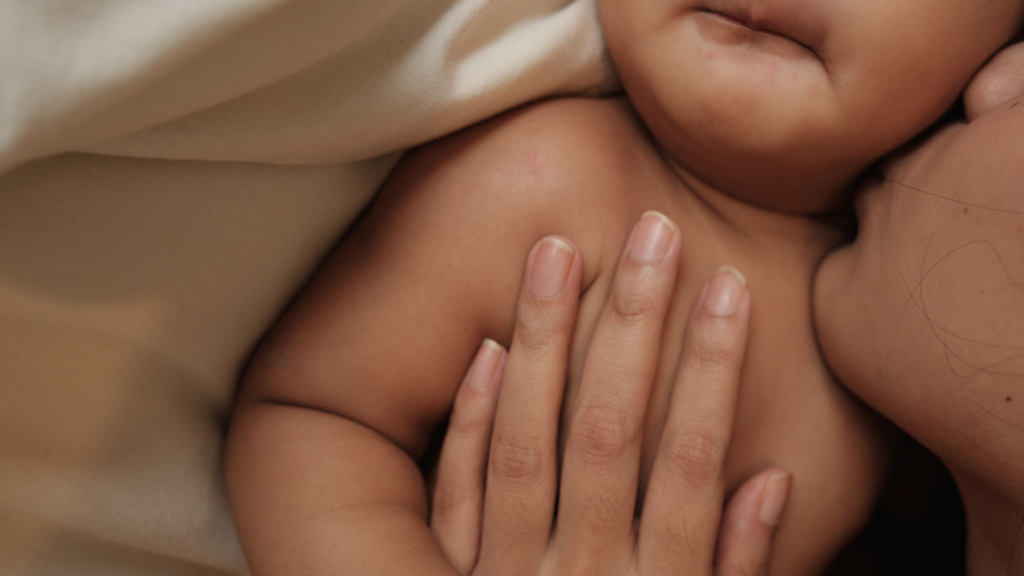
We celebrate pregnancy. We plan elaborate baby showers. We obsess over nursery decor, the perfect stroller, and which swaddle technique will magically make the baby sleep.
And then the baby arrives, and we expect the mother to just… bounce back.
Back to work. Back to her pre-pregnancy body. Back to “normal” as quickly as possible.
We treat birth like a finish line instead of a beginning. Like the hard part is over, when in reality, it’s just starting.
The postpartum period, often called the “fourth trimester”, is one of the most sacred and overlooked transitions in a woman’s life. After birth, your body has undergone a monumental journey. Now begins the process of repair, recovery, and renewal.
In our culture, so much attention is given to pregnancy and birth, yet the weeks and months after delivery are just as critical. Without the right care, many women feel depleted, overwhelmed, or unsupported [1].
This is not how it’s always been. And it’s not how it should be.

In traditional cultures around the world, the postpartum period has been treated as sacred for thousands of years.
Not just important. Not just recommended.
Sacred.
In Chinese culture, the first 30-40 days postpartum are called zuo yuezi, literally, “sitting the month.”
During this time:
The goal: Allow the mother’s body to fully recover so she has strength for the decades of mothering ahead.
Violating these practices is believed to leave the mother vulnerable to chronic health issues later in life, joint pain, digestive problems, chronic fatigue, depression.
Western medicine might call this correlation, not causation. But when a practice has persisted for thousands of years across one of the world’s oldest continuous cultures, maybe we should pay attention.
In Latin American traditions, la cuarentena is a 40-day period of intentional rest and protection.
The practices include:
The underlying belief: Birth opens the body, physically, energetically, spiritually. The mother is vulnerable during this time and must be protected until she “closes” again.
In Ayurvedic medicine, the postpartum period is understood as a time when a woman’s vata dosha (the element of air and space) is extremely high.
High vata = dryness, coldness, instability, anxiety, depletion.
The antidote?
The goal is to bring vata back into balance, to ground, warm, nourish, and stabilize the mother so she doesn’t develop chronic vata imbalances (anxiety, insomnia, digestive issues, dry skin, joint pain).
Across Indigenous cultures worldwide, from Africa to South America to Native American tribes, there are remarkably similar postpartum practices:
The common thread across all these traditions?
Rest. Warmth. Nourishment. Community. Protection.
The message is universal and clear: A new mother is precious and vulnerable. She must be tended to like the sacred being she is.
Not as an afterthought. Not as a luxury. As an essential foundation for her long-term health and her ability to mother from a place of fullness instead of depletion.
Now compare that sacred, intentional care to the modern Western postpartum experience.
You give birth, often via major abdominal surgery (C-section) or significant vaginal trauma (tearing, episiotomy).
You’re kept in the hospital for 24-48 hours if you had a vaginal birth, maybe 3-4 days for a C-section.
You’re sent home with:
And then you’re on your own.
Your partner (if you have one) might get two weeks of paternity leave if you’re lucky. More likely, they get a few days and then they’re back to work.
Your mother (if she’s available and willing) might come help for a week. Then she leaves.
You’re expected to figure it out. Alone.
Meanwhile:
If you’re struggling, physically exhausted, emotionally overwhelmed, mentally foggy, you’re told it’s normal.
“Welcome to motherhood!”
It’s dismissed as sleep deprivation, “just hormones,” or “part of the deal.”
And if it gets really bad? If you develop postpartum depression, anxiety, or rage?
You’re prescribed an SSRI and sent on your way.
No one asks:
We treat postpartum mental health issues as a brain chemistry problem to be medicated, rather than a nervous system crisis and nutritional emergency to be supported.
Don’t get me wrong, medication can be life-saving and absolutely necessary for some women. I’m not anti-medication. I’m a pharmacist, for crying out loud.
But it shouldn’t be the first line of defense when we haven’t even tried the basics: rest, food, warmth, and community.
Let’s talk about what’s actually happening in a new mother’s body, because this isn’t just about tradition or cultural practices. This is physiology.
The average blood loss during vaginal birth is 500ml.
During a C-section, it’s 1000ml (that’s a liter, more than two full blood donations).
And if there were complications, hemorrhage, retained placenta, significant tearing, it can be much, much more.
Iron is essential for:
Low iron looks like: Crushing fatigue. Brain fog. Anxiety. Depression. Irritability. Weakened immunity. Cold hands and feet. Heart palpitations. Shortness of breath.
Sound familiar?
Traditional postpartum practices prioritize iron-rich foods:
Western postpartum?
We’re lucky if someone drops off a lasagna.
Most new mothers are surviving on whatever they can grab quickly, cereal, toast, crackers, maybe some fruit if they’re being “healthy.”
Meanwhile, they’re bleeding for 4-6 weeks postpartum (lochia), further depleting iron stores.
And then we wonder why they’re exhausted and depressed.
Pregnancy doesn’t just grow a baby. It depletes the mother’s nutrient stores to do it.
By the end of pregnancy, most women are depleted in:
If she’s breastfeeding, she’s still giving those nutrients away, about 500 extra calories per day worth of resources.
Breastmilk doesn’t just magically appear. It’s made from the mother’s body. If she’s not replenishing those nutrients through diet, she’s running on empty.
This isn’t laziness. This isn’t “baby blues.”
This is physiological depletion.
And it gets worse with each subsequent pregnancy if the mother doesn’t fully replenish between babies.
Second baby? More depleted.
Third baby? Even more depleted.
This is why traditional cultures insisted on 40 days of intensive nourishment. They understood that without it, the mother’s health would suffer, not just immediately, but for years or decades to come.
Let’s talk about the hormonal earthquake that happens after birth.
During pregnancy, estrogen and progesterone climb steadily higher for nine months. By the end of pregnancy, they’re at levels 10-100 times higher than normal.
Then, within 24 hours of birth, they plummet.
Estrogen and progesterone drop to near-zero. This is one of the most dramatic hormonal shifts a human body can experience, more extreme than puberty, more extreme than menopause.
At the same time:
These aren’t small adjustments.
These are seismic hormonal shifts happening while the mother is sleep-deprived, nutrient-depleted, and healing from physical trauma.
Estrogen isn’t just about reproduction. It affects:
Progesterone isn’t just about pregnancy. It affects:
So when these hormones crash, the mother doesn’t just feel “a little off.”
She feels like she’s losing her mind.
And instead of supporting her through this massive physiological transition with rest, nourishment, and nervous system regulation, we tell her it’s normal and hand her an antidepressant.
(For more on how our nervous systems respond to overwhelming physiological and emotional shifts, read: Micro-Shifts, Major Healing: A Nervous System Approach to Change)
A new mother’s nervous system is on high alert. Constantly.
She’s biologically wired to be hypervigilant to her baby’s needs. Every cry activates her stress response. Every sound wakes her from sleep (if she’s sleeping at all). She’s constantly scanning: Is the baby breathing? Is the baby too hot? Too cold? Hungry? In pain?
This is a feature, not a bug.
This hypervigilance is adaptive, it keeps the baby alive. It’s how our species survived.
But it’s unsustainable without support.
In traditional cultures, other women hold the container so the mother can rest. They watch the baby while she sleeps. They bring her food. They protect her space so her nervous system can downregulate.
In modern culture?
She’s doing it alone, often while also trying to maintain a household, manage visitors, respond to texts asking “How are you?!”, pump if she’s going back to work soon, and “get back to normal.”
Her nervous system never gets a break.
She’s stuck in sympathetic activation (fight-or-flight mode) 24/7.
And we wonder why she’s anxious, exhausted, and can’t sleep even when the baby does sleep.
Chronic sympathetic activation causes:
This isn’t a personal failing. This is a nervous system that needs regulation and support.
And you can’t regulate a dysregulated nervous system with willpower or positive thinking.
You need:
All the things traditional postpartum practices provide.
Here’s what I keep coming back to:
The disrespect we’ve been inflicting on the natural world is an exact mirror of the disrespect we inflict on new mothers.
We expect the earth to produce endlessly without replenishment.
We expect mothers to produce endlessly (milk, care, labor) without replenishment.
We extract resources from the soil until it’s depleted, then wonder why crops fail.
We extract resources from mothers until they’re depleted, then wonder why they’re depressed.
We poison the water, air, and soil with chemicals, then act surprised when people get sick.
We ignore the nutritional depletion of mothers, then act surprised when they develop chronic illness.
And here’s the kicker:
We think we can technology our way out of both problems.
We think we can fix depleted soil with synthetic fertilizers instead of regenerating it naturally.
We think we can fix depleted mothers with antidepressants instead of nourishing them properly.
No amount of expensive CRISPR gene technology, precision medicine, or pharmaceutical interventions will EVER make the same level of impact as becoming better stewards of our water, air, and soil.
And no amount of psychiatric medication will fix what is fundamentally a crisis of care, nourishment, and community.
You cannot out-medicate, out-supplement, or out-biohack a toxic environment, whether that’s environmental toxins or a toxic postpartum culture that isolates and depletes new mothers.
The health of our bodies is inextricably linked to the health of our planet.
And both are suffering from the same disease: extraction without regeneration, depletion without replenishment, taking without giving back.
If we want to heal mothers, we need to remember what traditional cultures knew: You cannot pour from an empty cup. You must fill the mother so she can nourish the child.
If we want to heal the planet, we need to apply the same wisdom: You cannot extract endlessly without replenishing. You must regenerate what you’ve depleted.
Same principle. Same solution.
Nourishment. Rest. Regeneration. Care.
I want to be very clear about something:
Clinical postpartum depression and postpartum psychosis are real, serious conditions that sometimes require medication and intensive professional intervention.
But here’s what we don’t talk about enough:
Many, maybe even most, cases of “postpartum depression” are actually:
Severe iron deficiency (which looks exactly like depression: crushing fatigue, brain fog, low mood, anxiety, irritability, no motivation)
Thyroid dysfunction (postpartum thyroiditis causes both hyperthyroid and hypothyroid symptoms, including mood swings, anxiety, depression, and fatigue)
Vitamin D deficiency (strongly linked to depression, immune dysfunction, and bone loss)
B vitamin depletion (B12 and folate are essential for neurotransmitter production, without them, your brain can’t make serotonin or dopamine)
Magnesium deficiency (causes anxiety, insomnia, muscle tension, irritability, all mistaken for postpartum anxiety)
Severe sleep deprivation (literally a form of torture; chronic sleep deprivation causes depression, anxiety, cognitive impairment, and emotional dysregulation)
Nervous system dysregulation from chronic activation without support (stuck in fight-or-flight with no relief)
Lack of nourishment (trying to run a body and produce milk on crackers, coffee, and granola bars)
Social isolation (humans are not meant to raise babies alone; isolation is a known risk factor for depression)
Unprocessed birth trauma (especially if the birth was medically traumatic or if the mother felt disrespected, unheard, or violated)
And we slap an SSRI on it and call it treated.
Here’s what they don’t teach us in pharmacy school:
We learn about SSRIs for postpartum depression. We learn about the pharmacokinetics, the side effects, the risks of breastfeeding while on psychiatric medications. We counsel patients on what to expect.
We don’t learn to ask if she’s eaten today.
We don’t learn to ask if she’s sleeping, actual sleep, not just “when the baby sleeps.”
We don’t learn to check her iron levels before prescribing antidepressants (even though iron deficiency causes the exact same symptoms and is extremely common postpartum).
We don’t ask about her thyroid (even though postpartum thyroiditis is common and frequently missed, and treating it can resolve “depression” completely).
We don’t consider that her body just went through massive physiological trauma and depletion and might need replenishment, not just medication.
We treat her mental health like it exists in a vacuum, separate from her physical state, her nutritional status, her sleep, her support system, her nervous system regulation.
And then we wonder why postpartum depression rates keep climbing.
Here’s what I wish we did instead:
BEFORE prescribing an antidepressant, we screen for:
We ask:
We recommend:
THEN, if needed after addressing the foundation, we consider medication.
It’s not either/or. It’s both/and.
But let’s not skip the foundation.
Because here’s the truth: A lot of women are being medicated for nutritional deficiencies, sleep deprivation, and lack of support.
And while the medication might help with symptoms, it doesn’t address the root cause.
You can’t antidepressant your way out of severe iron deficiency.
You can’t medicate away chronic sleep deprivation.
You can’t pill your way to health when your body is literally depleted of the nutrients it needs to make neurotransmitters.
I’m not saying medication is never needed. Sometimes it absolutely is.
But we owe women more than just a prescription.
We owe them the same care traditional cultures have been giving for thousands of years:
Rest. Nourishment. Warmth. Community. Protection.
The basics.
We’re in a maternal health crisis.
Postpartum depression and anxiety are at all-time highs.
Maternal mortality in the U.S. is worse than most developed countries (and getting worse, not better).
Women are more depleted, more isolated, more unsupported than ever before.
And instead of addressing the root causes, lack of rest, lack of nourishment, lack of community, lack of systemic support, we’re just medicating the symptoms.
This is not sustainable.
Not for individual women. Not for families. Not for society.
We cannot continue to treat new mothers like they’re disposable.
Like they should just bounce back.
Like their needs don’t matter.
Like their depletion is normal and acceptable.
It’s not.
And the ancestral wisdom is right there, waiting for us to remember it.
40 days of rest.
Warm, nourishing foods.
Mineral-rich broths and iron-building meals.
Belly binding and physical support.
Community care, other women tending to the mother so she can tend to the baby.
Protection from cold, stress, and depletion.
This isn’t ancient superstition. This is physiology.
And it works.
So now you know why this matters.
You understand the physiology of postpartum depletion.
You see how modern culture has failed new mothers.
You recognize that what we’re calling “postpartum depression” is often actually nutritional deficiency, sleep deprivation, and lack of support.
But knowing isn’t enough.
The question is: What do we actually DO about it?
How do you honor the fourth trimester in a culture that doesn’t support it?
How do you get the rest, nourishment, and community care you need when you’re isolated in a nuclear family household?
What herbs actually help? What foods rebuild depleted bodies? How do you support physical recovery? How do you regulate a dysregulated nervous system?
That’s what we’re covering next.
👉 Read the companion piece: Postpartum Healing: Herbs, Foods, and Practices for Recovery
In that post, you’ll get:
This is the practical how-to guide to go with the why-it-matters foundation you just read.
May you be held the way you are holding your baby.
May you be fed the way you are feeding your child.
May you be mothered so you can mother.
May you know that your healing matters.
That your rest is productive.
That your nourishment is essential.
That you are not meant to do this alone.
May you be wrapped in warmth, physically, emotionally, spiritually.
May you be protected from the cold, the cold air, the cold food, the cold judgment of a culture that doesn’t understand what you need.
May you have 40 days. Or 60. Or 90. However long it takes.
May you know that this is not the time to bounce back.
This is the time to be reborn.
And rebirth requires tending.
We cannot go back to traditional village structures where extended family lives together and women naturally care for new mothers.
But we can remember. We can reclaim. We can recreate.
We can make honoring the fourth trimester cool again.
We can:
This is how we heal the postpartum crisis.
Not with more medication (though sometimes needed).
Not with more baby gear (the baby doesn’t need another swing).
With nourishment. Rest. Warmth. Community.
One mother at a time.
If you’re in your fourth trimester right now:
You are doing sacred work. Your body just performed a miracle. You deserve to be cared for.
If no one has said this to you: You need to eat. You need to rest. You need help.
Not when the baby sleeps (because the baby might not sleep).
Not after you’ve done the dishes.
Now.
Ask for help. Accept help. Demand help if necessary.
You are worth it.
Want the practical guide?
Read: Postpartum Healing: Herbs, Foods, and Practices for Recovery
Preparing for postpartum before baby arrives?
Read: Preparing for a Healthy Pregnancy 101
Need support for nervous system regulation?
Read: Micro-Shifts, Major Healing: A Nervous System Approach to Change
Want to understand the broader context of how we’ve lost ancestral wisdom?
Read: How Do We Hold Humanity While the Matrix Unravels?
Ready for personalized support?
👉 Book a complimentary discovery call with me here.
To your nourishment and healing,
Marina Buksov, PharmD
Holistic Health Coach | Herbalist | Mental Fitness Coach
References:
[1] Rudman, Ann, and Ulla Waldenström. 2007. “Critical Views on Postpartum Care Expressed by New Mothers.” BMC Health Services Research 7 (1). https://doi.org/10.1186/1472-6963-7-178.
[2] Pelling, Elissa. 2017. “TCM And Postpartum Traditions.” Elissa Pelling. September 4, 2017. https://elissapelling.com.au/tcm-and-postpartum-traditions/.
[3] Lopez-Gonzalez, Diorella M., and Anil K. Kopparapu. 2022. “Postpartum Care of the New Mother.” StatPearls – NCBI Bookshelf. December 11, 2022. https://www.ncbi.nlm.nih.gov/books/NBK565875/.
→ Want more herbal wisdom like this? Start here.
If you’re feeling stuck, overwhelmed, or unsure where to start on your herbal journey, I’m here to help.
Let’s talk it through together.
I offer a free discovery call where we’ll explore your health or holistic professional career goals and map out supportive first steps tailored just for you.
Book a Complimentary Health Consultation
Book a Holistic Professional Tea Chat
 Ready to transform your medicine cabinet? The Natural Medicine Makeover Guide helps you swap synthetic fixes for safe, effective natural remedies. Packed with expert tips from a pharmacist + herbalist, it’s your go-to resource for a healthier, holistic lifestyle. Plus, see my favorite products in my herbal dispensary.